AMYBIA project
Aggregating MYriads of Biologically-Inspired Agents
Internship position
Hardware simulations of massively distributed stochastic systems
Supervisor : Bernard Girau, researcher at INRIA institute,
Nancy, France. Hosting research teams: MAIA
and CORTEX
Scientific context
This short-term engineer position is open for candidates eager to develop hardware implementations of innovative schemes for decentralised and massively distributed computing. It is part of the hardware-theory codesign approach that guides the AMYBIA project, which
gathers researchers from three INRIA teams: MAIA, CORTEX, and ALCHEMY. Our aim is to unite our
research on bio-inspired modelling at three complementary levels: the modelling
level, the simulation level and the hardware level.
As a first objective, we consider the problem of dynamically allocating a
large set of computing units, in the presence of evolving faults or defects. As
a specific problem, we consider the decentralised gathering problem that
consists in grouping at the same location agents that move on a grid and that
are initially randomly scattered on this grid. The main constraint here is that
the agents can only see their immediate neighbourhood. Moreover, they cannot
directly communicate with each other: all they can do is to send simple
messages, called 'influences', to their environment. The effects of these
influences are of course not known in advance.
The questions raised are: What are the simplest models than can perform this
task? What are the simulations tools for simulating such systems on a large
scale? What are the appropriate computational devices for performing such
agent-based simulations?
Activities
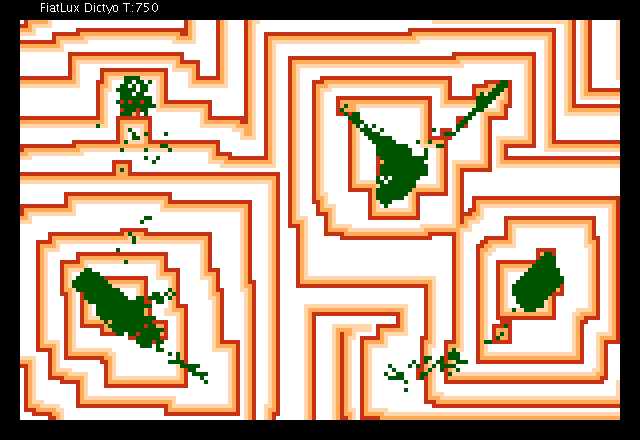
We start studying the decentralised gathering problem through a prototype model that is inspired from the aggregation phenomenon in the social bacteria Dictyostelium discoideum. Visit our web page to see a detailed description of the model (paper preprint and demos). From the hardware point of view, we aim at developping large-scale and rapid implementation methods on FPGAs, and to use this hardware study so as to redefine the prototype model along hardware-friendly principles. The activities we propose to the candidate lie within this hardware work:
- to develop efficient and reliable random number generator systems to handle the stochastic aspects of the model
- to implement the environment model, and to validate its accuracy w.r.t. software simulations
- to study large-scale extensions (e.g. block-synchronous) of this implemented model
- to analyse the main obstacles towards the implementation of the aggregating agents
Profile
Skills in both computer science and circuit design are welcome. Candidates should have some knowledge in massively parallel systems such as cellular automata and multi-agent systems. They should have experience in VHDL programming, possibly on FPGAs. This position is open to last-year engineering students.
Contact
- mail : Bernard.Girau@loria.fr
- tel : +33 3 83 59 20 58
Click here to visit
the web page of the AMYBIA project.
The duration of the contract is 4
months by default ; please contact us if you need to adjust this.