– LORIA/NeuroRhythms
– Federal University of Rio Grande do Norte/Laboratory of Technological Innovation in Health (Brasil)
– LORIA/NeuroRhythms
– Federal University of Rio Grande do Norte/Laboratory of Technological Innovation in Health (Brasil)
Rendez-vous Mardi 20 juin 2023 à partir de 13h : Lien de l’évènement pour assister à la conférence.
L’accident vasculaire cérébral (AVC) est la première cause de handicap acquis chez l’adulte. Cette conférence présentera les causes, les facteurs de risques principaux et les conséquences motrices, sensitives et cognitives d’un AVC. Nous aborderons les thérapies conventionnelles mises en place et l’apport des interfaces cerveau-ordinateur en suivant la conception et l’évaluation de l’utilisabilité, de l’utilité et de la désirabilité d’un dispositif d’aide à la rééducation motrice du membre supérieur. Ce dispositif vise à soutenir l’imagination motrice kinesthésique utilisée comme thérapie par la présentation de neurofeedbacks visuel, haptique et tangible dans un environnement ludifié.
Intervenants :
Laurent Bougrain est maître de conférences en informatique à l’université de Lorraine et responsable de l’équipe de recherche NeuroRhythms du Laboratoire Lorrain de Recherche en Informatique et ses Applications (LORIA).
Claudie Chauvière est cadre de santé en kinésithérapie au centre de médecine physique et de réadaptation neurologique de Lay-Saint-Christophe de l’institut régional de réadaptation (IRR).
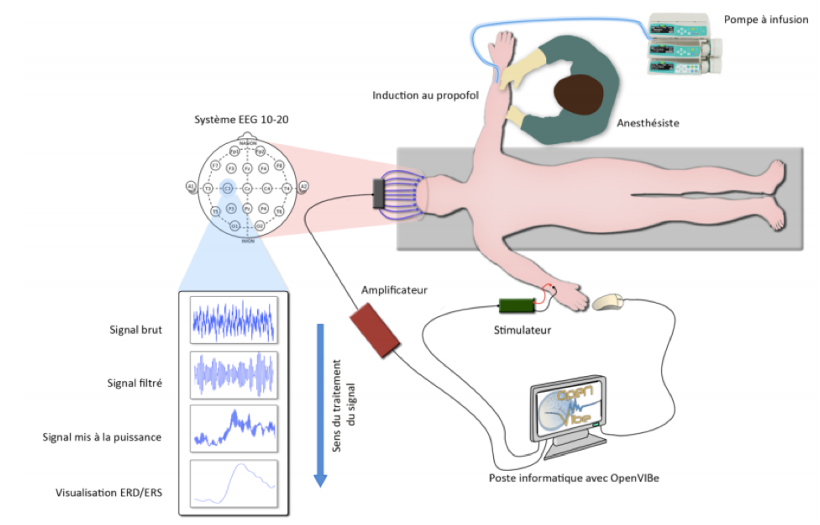
The BCI4IA project proposes to detect intraoperative awareness reliably by analyzing, in real-time, brain motor activity under general anesthesia with a Brain-Computer Interface (BCI) based on Median Nerve Stimulation and innovative machine learning methods.
– University hospital of Nancy;
– University of Lorraine/LORIA/Neurorhythms;
– Inria Potioc;
– University hospital of Brugmann (Belgium).
On July 28 at 13:30h – 17:00 in NYC, I will participate to introduce the worldwide used open source software OpenViBE for designing and process on-line neuroscience experiments at the OpenViBE workshop during the join meeting of the 4rd Neuroergonomics Conference 2022 & the Neuromodulation conference 2022! Who’s attenting?
see https://neuromodec.org/neuroergonomics-nycn-2022/workshops.html
On May 23-34, 2022, six laboratories on the Illkirch campus (univ. of Strasbourg) organize joint scientific days
I have been invited to participate to a plenary session on human/machine symbiosis and artificial intelligence. I will present my work on deep learning and transfer learning for the detection of motor brain electrical activity.
Program here
On September 11 at 14:00h – 18:00 CET, I will participate to introduce the worldwide used open source software OpenViBE for designing and process on-line neuroscience experiments at the OpenViBE workshop during the 3rd Neuroergonomics Conference 2021! Who’s attenting?
see https://www.neuroergonomicsconference.um.ifi.lmu.de/tutorials-workshops/
On November 2, 2020, a very interesting workshop is organized bringing together the CNRS, the Academy of Technologies and the National Academy of Medicine on brain-machine interfaces.
I will present two projects on the detection of peroperative awereness and the design and evaluation of a haptic and tangible brain-compututer interface for stroke patients (ANR Grasp-IT).
Program and free registration: here
Congratulations to Sébastien Rimbert who received the award for best student paper from IEEE and the Brain initiative at Brain-Machine Interfaces workshop of the 2020 System Man and Cybernetic (SMC’20) conference!
You can read the article « Learning How to Generate Kinesthetic Motor Imagery Using a BCI-based Learning Environment: a Comparative Study Based on Guided or Trial-and-Error Approaches » by
Sébastien Rimbert, Laurent Bougrain and Stéphanie Fleck
here https://hal.inria.fr/hal-02920306